Home · Research Catalog · Tesamorelin
Growth-Factor Research · Secretagogue ClassTesamorelin: Research Overview
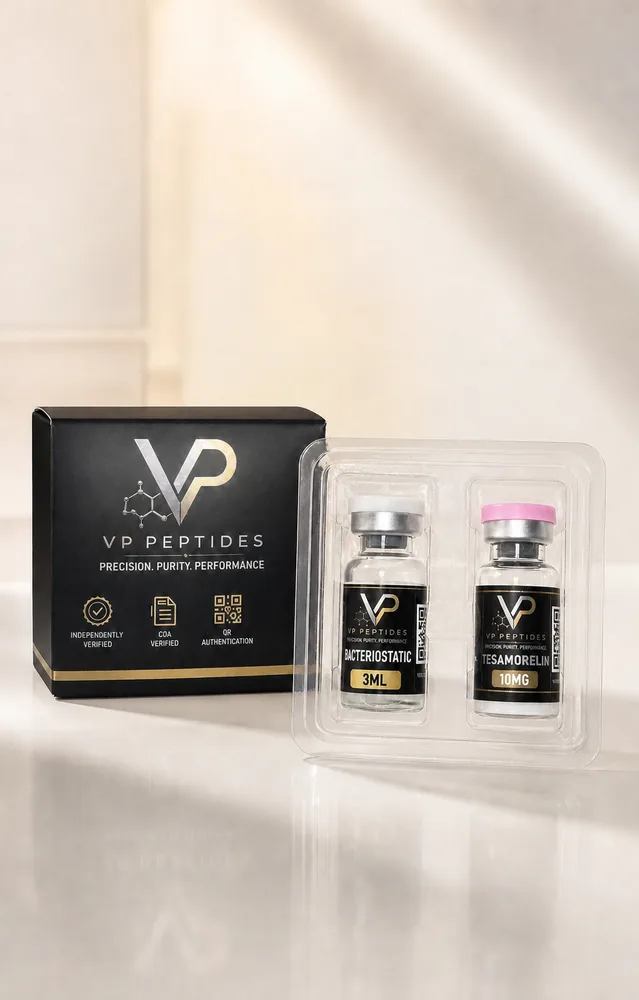
An FDA-approved pharmaceutical containing tesamorelin exists (Egrifta / Egrifta WR). That does not make a research-grade vial of tesamorelin an FDA-approved medicine. VP Peptides research material is not that approved drug product, is not manufactured to its specification, and is supplied strictly for laboratory research.
Technical profile
| Compound | Tesamorelin |
|---|---|
| Class | Synthetic 44-amino-acid GHRH analog with a trans-3-hexenoyl N-terminal modification |
| Molecular weight | ~5135.9 g/mol |
| Receptor target | GHRH receptor |
| Form supplied | Lyophilized powder, sealed vial |
| Storage | Lyophilized: 2–8 °C, protected from light. |
| Verification | HPLC purity ≥99%, sterility, endotoxins, heavy metals — documented on the batch COA |
Evidence at a glance
Research evidence is not one category. Human, animal (preclinical) and in-vitro / mechanistic data differ in strength — often sharply. VP Peptides separates them so no single line overstates the whole picture. Ratings are deliberately conservative and describe the published evidence base, not any effect in humans.
- Whether the research material matches the approved product in identity, purity or potency
- Human efficacy or safety of the research material as sold for any non-approved use
- Long-term human safety of the research material specifically
What does the research literature cover?
Tesamorelin occupies an unusual place in the secretagogue-class literature because a pharmaceutical form of the molecule went through full clinical development. Research-grade material is studied in the context of:
- GHRH-receptor pharmacology: tesamorelin as a full-length GHRH analog whose N-terminal trans-3-hexenoyl modification is described in the literature as conferring resistance to enzymatic degradation relative to native GHRH.
- Growth-hormone-axis models: laboratory studies of GHRH-receptor signaling and downstream axis regulation using stabilized GHRH analogs as tool compounds.
- Comparative analog studies: experimental designs comparing full-length analogs such as tesamorelin with truncated GHRH(1-29) analogs such as sermorelin.
Important context: the clinical literature on tesamorelin concerns the pharmaceutical product developed under regulatory oversight — not research-grade material. Nothing on this page is a claim about effects in humans, and research-grade tesamorelin has no approved use.
Why purity matters for tesamorelin research
At 44 amino acids, tesamorelin is one of the longer peptides in the secretagogue class, and longer synthetic sequences carry a higher risk of truncation and deletion impurities. Every VP Peptides tesamorelin batch ships with a Certificate of Analysis documenting ≥99% HPLC purity, sterility, endotoxin and heavy-metal testing from independent third-party testing.
Request catalog accessFrequently asked questions
Is this the same as the prescription drug Egrifta?
No. Pharmaceutical tesamorelin is an FDA-approved prescription drug marketed as Egrifta, manufactured under pharmaceutical GMP and dispensed only by prescription. Research-grade tesamorelin is NOT that drug: it is laboratory material supplied for in-vitro and preclinical research only, and it may not be used in humans under any circumstances.
Is research-grade tesamorelin approved for human use?
No. Research-grade tesamorelin is not approved for human use in any jurisdiction. It is supplied strictly as a research chemical for laboratory investigation. It is not a drug, supplement, or food ingredient, and it is not a substitute for any prescription product.
How should tesamorelin be stored in the lab?
Lyophilized vials should be kept at 2–8 °C and protected from light.
What is tesamorelin's status in competitive sport?
Growth-hormone secretagogues and GHRH analogs, including tesamorelin, are listed as prohibited substances under the World Anti-Doping Agency (WADA) Prohibited List. This is noted for informational purposes only; VP Peptides materials are supplied solely for laboratory research.
GHRH / GH–IGF-1 axis science, in context
Tesamorelin belongs to the growth-hormone-releasing hormone (GHRH) family, and the research literature describes it as a stabilized analog of the endogenous 44-amino-acid hypothalamic peptide. In classical endocrine physiology, GHRH released from the hypothalamus binds the GHRH receptor on pituitary somatotrophs and prompts the pulsatile secretion of endogenous growth hormone (GH); circulating GH in turn drives hepatic and peripheral production of insulin-like growth factor 1 (IGF-1). This hypothalamic–pituitary–hepatic relay is commonly summarized as the GH–IGF-1 axis. Because tesamorelin acts upstream — stimulating the body's own GH release rather than supplying GH directly — it is characterized in the literature as a secretagogue, and its N-terminal trans-3-hexenoyl modification is described as conferring resistance to enzymatic breakdown relative to native GHRH, extending its usefulness as a tool compound in axis-signaling models.
The molecule's clinical pedigree is specific and narrow. A pharmaceutical formulation of tesamorelin is FDA-approved under the brand names Egrifta and Egrifta WR as a growth-hormone-releasing factor analog for the reduction of excess abdominal fat in patients with HIV-associated lipodystrophy, a use established through controlled trials of the drug product (Falutz et al., 2007; FDA label). That approval attaches to a regulated pharmaceutical manufactured to a defined specification — not to research-grade material. The tesamorelin supplied here is not that approved drug product, is not made to its pharmaceutical standard, and carries no approved indication; it is intended solely for in-vitro and preclinical laboratory research. The mechanistic and clinical summaries above describe the published record on the GHRH class and the pharmaceutical product; they are not statements about the research material or about effects in humans (Stanley & Grinspoon, 2012).
Selected research references
- ClinicalTrials.gov — NCT03375788 (2019)
- Falutz J, et al. Metabolic effects of a growth hormone-releasing factor in patients with HIV. N Engl J Med. 2007;357(23):2359–2370.
- EGRIFTA WR (tesamorelin for injection) — FDA Prescribing Information.
- Stanley TL, Grinspoon SK. Growth hormone and tesamorelin in the management of HIV-associated lipodystrophy. HIV AIDS (Auckl). 2012;4:171–179.
Related research compounds
Inicio · Catálogo de investigación · Tesamorelina
Investigación de factores de crecimiento · Clase secretagogosTesamorelina: Descripción general para investigación
Existe un fármaco aprobado por la FDA que contiene tesamorelina (Egrifta / Egrifta WR). Eso no convierte a un vial de tesamorelina de grado investigación en un medicamento aprobado por la FDA. El material de investigación de VP Peptides no es ese medicamento aprobado, no se fabrica según su especificación y se suministra estrictamente para investigación de laboratorio.
Perfil técnico
| Compuesto | Tesamorelina |
|---|---|
| Clase | Análogo sintético de GHRH de 44 aminoácidos con una modificación N-terminal trans-3-hexenoílo |
| Peso molecular | ~5135.9 g/mol |
| Diana del receptor | Receptor de GHRH |
| Forma suministrada | Polvo liofilizado, vial sellado |
| Almacenamiento | Liofilizado: 2–8 °C, protegido de la luz. |
| Verificación | Pureza HPLC ≥99%, esterilidad, endotoxinas, metales pesados — documentado en el COA del lote |
Evidencia de un vistazo
La evidencia de investigación no es una sola categoría. Los datos humanos, animales (preclínicos) e in vitro / mecanísticos difieren en solidez — a menudo de forma marcada. VP Peptides los separa para que ninguna línea exagere el panorama completo. Las valoraciones son deliberadamente conservadoras y describen la base de evidencia publicada, no ningún efecto en humanos.
- Si el material de investigación coincide con el producto aprobado en identidad, pureza o potencia
- La eficacia o seguridad en humanos del material de investigación tal como se vende para cualquier uso no aprobado
- La seguridad a largo plazo en humanos del material de investigación en concreto
¿Qué cubre la literatura de investigación?
La tesamorelina ocupa un lugar inusual en la literatura de la clase de los secretagogos porque una forma farmacéutica de la molécula pasó por un desarrollo clínico completo. El material de grado investigación se estudia en el contexto de:
- Farmacología del receptor de GHRH: la tesamorelina como análogo de GHRH de longitud completa cuya modificación N-terminal trans-3-hexenoílo se describe en la literatura como confiriendo resistencia a la degradación enzimática en relación con la GHRH nativa.
- Modelos del eje de la hormona del crecimiento: estudios de laboratorio de la señalización del receptor de GHRH y la regulación del eje aguas abajo utilizando análogos de GHRH estabilizados como compuestos herramienta.
- Estudios comparativos de análogos: diseños experimentales que comparan análogos de longitud completa como la tesamorelina con análogos truncados de GHRH(1-29) como la sermorelina.
Contexto importante: la literatura clínica sobre la tesamorelina se refiere al producto farmacéutico desarrollado bajo supervisión regulatoria — no al material de grado investigación. Nada en esta página constituye una afirmación sobre efectos en humanos, y la tesamorelina de grado investigación no tiene ningún uso aprobado.
Por qué importa la pureza en la investigación con tesamorelina
Con 44 aminoácidos, la tesamorelina es uno de los péptidos más largos de la clase de los secretagogos, y las secuencias sintéticas más largas conllevan un mayor riesgo de impurezas por truncamiento y deleción. Cada lote de tesamorelina de VP Peptides se envía con un Certificado de Análisis que documenta una pureza HPLC ≥99%, esterilidad, endotoxinas y pruebas de metales pesados realizadas por terceros independientes.
Solicitar acceso al catálogoPreguntas frecuentes
¿Es lo mismo que el medicamento de prescripción Egrifta?
No. La tesamorelina farmacéutica es un medicamento de prescripción aprobado por la FDA comercializado como Egrifta, fabricado conforme a las normas GMP farmacéuticas y dispensado solo con receta. La tesamorelina de grado investigación NO es ese fármaco: es material de laboratorio suministrado únicamente para investigación in vitro y preclínica, y no puede usarse en humanos bajo ninguna circunstancia.
¿Está aprobada para uso humano la tesamorelina de grado investigación?
No. La tesamorelina de grado investigación no está aprobada para uso humano en ninguna jurisdicción. Se suministra estrictamente como producto químico de investigación para estudio de laboratorio. No es un fármaco, suplemento ni ingrediente alimentario, y no sustituye a ningún producto de prescripción.
¿Cómo debe almacenarse la tesamorelina en el laboratorio?
Los viales liofilizados deben conservarse a 2–8 °C y protegidos de la luz.
¿Cuál es el estatus de la tesamorelina en el deporte de competición?
Los secretagogos de la hormona del crecimiento y los análogos de GHRH, incluida la tesamorelina, figuran como sustancias prohibidas en la Lista de Prohibiciones de la Agencia Mundial Antidopaje (AMA/WADA). Esto se indica únicamente con fines informativos; los materiales de VP Peptides se suministran exclusivamente para investigación de laboratorio.
La ciencia del eje GHRH / GH–IGF-1, en contexto
La tesamorelina pertenece a la familia de la hormona liberadora de la hormona del crecimiento (GHRH), y la literatura de investigación la describe como un análogo estabilizado del péptido hipotalámico endógeno de 44 aminoácidos. En la fisiología endocrina clásica, la GHRH liberada por el hipotálamo se une al receptor de GHRH en los somatotropos de la hipófisis y desencadena la secreción pulsátil de hormona del crecimiento (GH) endógena; la GH circulante, a su vez, impulsa la producción hepática y periférica del factor de crecimiento insulínico tipo 1 (IGF-1). Este relevo hipotálamo–hipófisis–hígado se resume habitualmente como el eje GH–IGF-1. Dado que la tesamorelina actúa aguas arriba — estimulando la propia liberación de GH del organismo en lugar de aportar GH directamente — se caracteriza en la literatura como un secretagogo, y su modificación N-terminal trans-3-hexenoílo se describe como confiriendo resistencia a la degradación enzimática en relación con la GHRH nativa, lo que prolonga su utilidad como compuesto herramienta en modelos de señalización del eje.
El historial clínico de la molécula es específico y acotado. Una formulación farmacéutica de tesamorelina está aprobada por la FDA bajo las marcas Egrifta y Egrifta WR como análogo del factor liberador de la hormona del crecimiento para la reducción del exceso de grasa abdominal en pacientes con lipodistrofia asociada al VIH, un uso establecido mediante ensayos controlados del medicamento (Falutz et al., 2007; ficha técnica de la FDA). Esa aprobación corresponde a un producto farmacéutico regulado fabricado según una especificación definida — no al material de grado investigación. La tesamorelina aquí suministrada no es ese medicamento aprobado, no se fabrica según su estándar farmacéutico y no tiene ninguna indicación aprobada; está destinada únicamente a investigación de laboratorio in vitro y preclínica. Los resúmenes mecanísticos y clínicos anteriores describen el registro publicado sobre la clase GHRH y el producto farmacéutico; no son afirmaciones sobre el material de investigación ni sobre efectos en humanos (Stanley y Grinspoon, 2012).
Referencias de investigación seleccionadas
- ClinicalTrials.gov — NCT03375788 (2019)
- Falutz J, et al. Metabolic effects of a growth hormone-releasing factor in patients with HIV. N Engl J Med. 2007;357(23):2359–2370.
- EGRIFTA WR (tesamorelina para inyección) — Información de prescripción de la FDA.
- Stanley TL, Grinspoon SK. Growth hormone and tesamorelin in the management of HIV-associated lipodystrophy. HIV AIDS (Auckl). 2012;4:171–179.