Home · Research Catalog · Ipamorelin
Growth-Factor Research · Secretagogue ClassIpamorelin: Research Overview
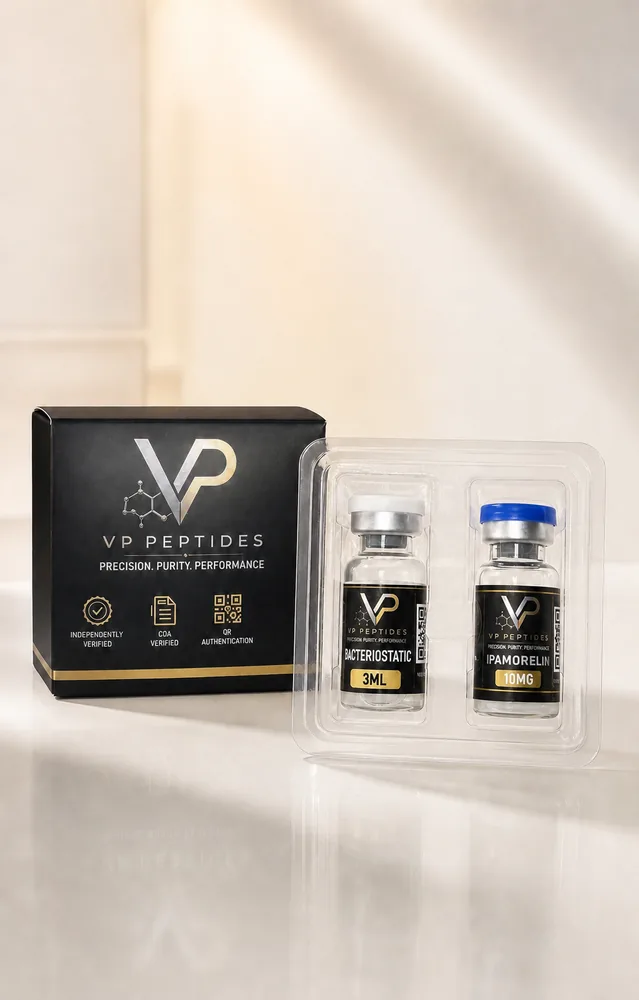
Ipamorelin is best described as GHSR / growth-hormone-secretagogue research. Human evidence is limited (an early Phase 2 program did not establish benefit). Avoid “muscle,” “recovery” or “fat-loss” framing.
Technical profile
| Compound | Ipamorelin |
|---|---|
| Class | Synthetic pentapeptide (5 amino acids); selective ghrelin-receptor (GHS-R1a) agonist |
| Molecular formula | C38H49N9O5 |
| Molecular weight | 711.9 g/mol |
| CAS number | 170851-70-4 |
| PubChem CID | 9831659 |
| Form supplied | Lyophilized powder, sealed vial |
| Storage | Lyophilized: 2–8 °C, protected from light. |
| Verification | HPLC purity ≥99%, sterility, endotoxins, heavy metals — documented on the batch COA |
Evidence at a glance
Research evidence is not one category. Human, animal (preclinical) and in-vitro / mechanistic data differ in strength — often sharply. VP Peptides separates them so no single line overstates the whole picture. Ratings are deliberately conservative and describe the published evidence base, not any effect in humans.
- Human efficacy for any indication — the limited Phase 2 human data did not establish benefit
- Long-term human safety of the research material
- Identity and purity of research-grade material sold as ipamorelin
What does the research literature cover?
Ipamorelin appears in the growth-hormone-secretagogue literature primarily as a tool compound for studying receptor selectivity. Published preclinical work has examined it in the context of:
- GHS-R1a pharmacology: receptor-binding and functional assays characterizing ipamorelin as an agonist of the ghrelin receptor, the same target engaged by the endogenous hormone ghrelin.
- Receptor selectivity models: preclinical studies in which ipamorelin showed minimal effect on cortisol and prolactin signaling relative to earlier secretagogues — the property for which it is most often cited in the literature.
- Comparative secretagogue studies: experimental designs comparing peptide secretagogues (such as hexarelin) and GHRH analogs across receptor pathways.
Important context: the published evidence base is preclinical (cell and animal models). Ipamorelin has no approved human use in any jurisdiction. Summaries here describe what researchers have studied — they are not claims about effects in humans.
Why purity matters for ipamorelin research
Receptor-selectivity research is only as reliable as the material in the vial. Truncated sequences, deletion impurities, or endotoxin contamination confound binding and functional assays. Every VP Peptides ipamorelin batch ships with a Certificate of Analysis documenting ≥99% HPLC purity plus sterility, endotoxin and heavy-metal testing from independent third-party testing.
Request catalog accessFrequently asked questions
Is ipamorelin approved for human use?
No. Ipamorelin is not approved by the FDA or any other regulatory agency for human use. It is supplied strictly as a research chemical for in-vitro and laboratory investigation. It is not a drug, supplement, or food ingredient.
What does "selective" mean in the ipamorelin literature?
In preclinical studies, ipamorelin activated the ghrelin receptor (GHS-R1a) while showing minimal effect on cortisol and prolactin signaling compared with earlier-generation secretagogues. That selectivity profile is why it is frequently used as a reference compound in receptor-pharmacology research.
How should ipamorelin be stored in the lab?
Lyophilized vials should be kept at 2–8 °C and protected from light.
What is ipamorelin's status in competitive sport?
Growth-hormone secretagogues are listed as prohibited substances under the World Anti-Doping Agency (WADA) Prohibited List. This is noted for informational purposes only; VP Peptides materials are supplied solely for laboratory research.
Ghrelin-receptor / GH-secretagogue science, in context
Ipamorelin belongs to a family of small synthetic peptides known as growth-hormone secretagogues — molecules that engage the growth-hormone-secretagogue receptor type 1a (GHS-R1a), the same G-protein-coupled receptor activated by the endogenous hormone ghrelin. In the receptor-pharmacology literature, ipamorelin is characterized as a selective agonist at this receptor. When it binds GHS-R1a on somatotroph cells of the anterior pituitary, the receptor couples through Gq/11 signaling to phospholipase C, generating intracellular second messengers that, in preclinical models, are associated with release of growth hormone from pituitary stores (Raun et al., 1998).
The property most frequently emphasized in the literature is selectivity. In the original preclinical characterization, ipamorelin stimulated growth-hormone release with little concurrent effect on cortisol- or prolactin-related signaling relative to earlier secretagogues — a receptor-level distinction that made it a useful reference compound for studying GHS-R1a activation itself. Broader reviews situate this receptor within a wider signaling network, describing its coupling behavior and its interactions with other G-protein-coupled receptors (Howick et al., 2022).
Human clinical evidence, by contrast, remains limited. Ipamorelin advanced into an early Phase 2 program — a randomized, placebo-controlled study in postoperative ileus after bowel resection — but that trial did not demonstrate a significant benefit over placebo on its efficacy endpoints (Beck et al., 2014). No subsequent program has established a human therapeutic use, and ipamorelin is not approved by the FDA or any other regulatory authority for any indication.
For laboratory researchers, this places ipamorelin as a mechanistic tool for probing ghrelin-receptor signaling and secretagogue pharmacology — not as an agent with demonstrated human outcomes.
Selected research references
- Raun et al., Eur J Endocrinol 1998
- Howick et al., J Neuroendocrinol 2022
- Beck et al., Int J Colorectal Dis 2014
Related research compounds
Inicio · Catálogo de investigación · Ipamorelina
Investigación de factores de crecimiento · Clase secretagogoIpamorelina: descripción general de la investigación
La ipamorelina se describe mejor como investigación de GHSR / secretagogos de la hormona del crecimiento. La evidencia humana es limitada (un programa temprano de Fase 2 no estableció beneficio). Evita los enfoques de “músculo”, “recuperación” o “pérdida de grasa”.
Perfil técnico
| Compuesto | Ipamorelin |
|---|---|
| Clase | Pentapéptido sintético (5 aminoácidos); agonista selectivo del receptor de grelina (GHS-R1a) |
| Fórmula molecular | C38H49N9O5 |
| Peso molecular | 711.9 g/mol |
| Número CAS | 170851-70-4 |
| PubChem CID | 9831659 |
| Forma suministrada | Polvo liofilizado, vial sellado |
| Almacenamiento | Liofilizado: 2–8 °C, protegido de la luz. |
| Verificación | Pureza por HPLC ≥99%, esterilidad, endotoxinas, metales pesados — documentado en el COA del lote |
Evidencia de un vistazo
La evidencia de investigación no es una sola categoría. Los datos humanos, animales (preclínicos) e in vitro / mecanísticos difieren en solidez — a menudo de forma marcada. VP Peptides los separa para que ninguna línea exagere el panorama completo. Las calificaciones son deliberadamente conservadoras y describen la base de evidencia publicada, no ningún efecto en humanos.
- La eficacia en humanos para cualquier indicación — los limitados datos humanos de Fase 2 no establecieron beneficio
- La seguridad humana a largo plazo del material de investigación
- La identidad y pureza del material de grado investigación vendido como ipamorelina
¿Qué cubre la literatura de investigación?
La ipamorelina aparece en la literatura de secretagogos de la hormona del crecimiento principalmente como compuesto de herramienta para estudiar la selectividad de receptor. El trabajo preclínico publicado la ha examinado en el contexto de:
- Farmacología de GHS-R1a: ensayos de unión a receptor y funcionales que caracterizan a la ipamorelina como agonista del receptor de grelina, la misma diana que activa la hormona endógena grelina.
- Modelos de selectividad de receptor: estudios preclínicos en los que la ipamorelina mostró un efecto mínimo sobre la señalización de cortisol y prolactina en comparación con secretagogos anteriores — la propiedad por la que se cita con más frecuencia en la literatura.
- Estudios comparativos de secretagogos: diseños experimentales que comparan secretagogos peptídicos (como la hexarelina) y análogos de GHRH entre vías de receptor.
Contexto importante: la base de evidencia publicada es preclínica (modelos celulares y animales). La ipamorelina no tiene uso humano aprobado en ninguna jurisdicción. Los resúmenes aquí describen lo que los investigadores han estudiado — no son afirmaciones sobre efectos en humanos.
Por qué la pureza importa en la investigación con ipamorelina
La investigación de selectividad de receptor es tan fiable como el material del vial. Las secuencias truncadas, las impurezas por deleción o la contaminación por endotoxinas confunden los ensayos de unión y funcionales. Cada lote de ipamorelina de VP Peptides se envía con un Certificado de Análisis que documenta una pureza por HPLC ≥99% además de pruebas de esterilidad, endotoxinas y metales pesados realizadas por terceros independientes.
Solicitar acceso al catálogoPreguntas frecuentes
¿Está aprobada la ipamorelina para uso humano?
No. La ipamorelina no está aprobada por la FDA ni por ninguna otra agencia reguladora para uso humano. Se suministra estrictamente como sustancia química de investigación para estudios in vitro y de laboratorio. No es un fármaco, suplemento ni ingrediente alimentario.
¿Qué significa "selectiva" en la literatura sobre ipamorelina?
En estudios preclínicos, la ipamorelina activó el receptor de grelina (GHS-R1a) mostrando un efecto mínimo sobre la señalización de cortisol y prolactina en comparación con secretagogos de generaciones anteriores. Ese perfil de selectividad es la razón por la que se usa con frecuencia como compuesto de referencia en la investigación de farmacología de receptores.
¿Cómo debe almacenarse la ipamorelina en el laboratorio?
Los viales liofilizados deben mantenerse a 2–8 °C y protegidos de la luz.
¿Cuál es el estatus de la ipamorelina en el deporte de competición?
Los secretagogos de la hormona del crecimiento figuran como sustancias prohibidas en la Lista de Prohibiciones de la Agencia Mundial Antidopaje (AMA/WADA). Esto se indica solo con fines informativos; los materiales de VP Peptides se suministran únicamente para investigación de laboratorio.
La ciencia del receptor de grelina / secretagogos de GH, en contexto
La ipamorelina pertenece a una familia de pequeños péptidos sintéticos conocidos como secretagogos de la hormona del crecimiento — moléculas que se acoplan al receptor secretagogo de la hormona del crecimiento tipo 1a (GHS-R1a), el mismo receptor acoplado a proteína G que activa la hormona endógena grelina. En la literatura de farmacología de receptores, la ipamorelina se caracteriza como agonista selectivo de este receptor. Cuando se une al GHS-R1a en las células somatotropas de la hipófisis anterior, el receptor se acopla mediante la señalización Gq/11 a la fosfolipasa C, generando segundos mensajeros intracelulares que, en modelos preclínicos, se asocian con la liberación de hormona del crecimiento desde los depósitos hipofisarios (Raun et al., 1998).
La propiedad que más se subraya en la literatura es la selectividad. En la caracterización preclínica original, la ipamorelina estimuló la liberación de hormona del crecimiento con escaso efecto concurrente sobre la señalización relacionada con cortisol o prolactina en comparación con secretagogos anteriores — una distinción a nivel de receptor que la convirtió en un compuesto de referencia útil para estudiar la propia activación del GHS-R1a. Revisiones más amplias sitúan a este receptor dentro de una red de señalización mayor, describiendo su comportamiento de acoplamiento y sus interacciones con otros receptores acoplados a proteína G (Howick et al., 2022).
La evidencia clínica humana, en cambio, sigue siendo limitada. La ipamorelina avanzó a un programa temprano de Fase 2 — un estudio aleatorizado y controlado con placebo en íleo posoperatorio tras resección intestinal — pero ese ensayo no demostró un beneficio significativo frente al placebo en sus criterios de eficacia (Beck et al., 2014). Ningún programa posterior ha establecido un uso terapéutico en humanos, y la ipamorelina no está aprobada por la FDA ni por ninguna otra autoridad reguladora para ninguna indicación.
Para los investigadores de laboratorio, esto sitúa a la ipamorelina como una herramienta mecanística para estudiar la señalización del receptor de grelina y la farmacología de secretagogos — no como un agente con resultados demostrados en humanos.
Referencias de investigación seleccionadas
- Raun et al., Eur J Endocrinol 1998
- Howick et al., J Neuroendocrinol 2022
- Beck et al., Int J Colorectal Dis 2014