Home · Research Catalog · Epitalon
Longevity & Cellular Research · Research CompoundEpitalon: Research Overview
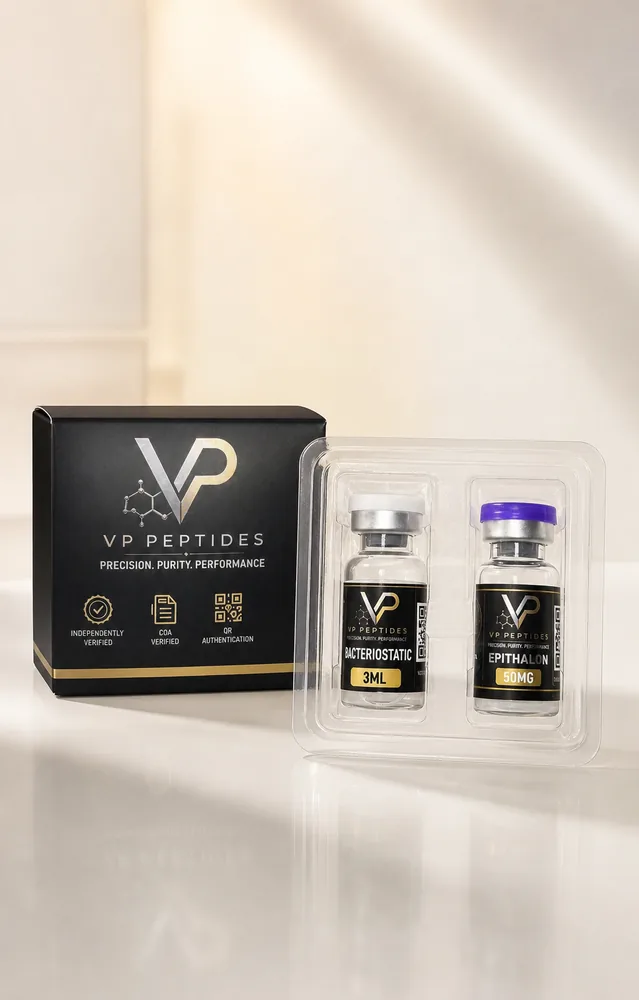
Epitalon’s most striking findings — telomerase activation and telomere elongation — come from human cell-culture models, not living people. Epitalon has demonstrated effects on telomerase activity and telomere biology in human cell cultures; whether these translate into meaningful clinical longevity outcomes remains unestablished. It does not “repair telomeres” or “reverse aging” in humans.
Technical profile
| Compound | Epitalon (Epithalon; Epithalone; AEDG peptide) |
|---|---|
| Class | Synthetic tetrapeptide (4 amino acids) |
| Sequence | Ala-Glu-Asp-Gly (AEDG) |
| Sequence origin | Developed from research on epithalamin, a bovine pineal gland extract — part of the Khavinson peptide series |
| Molecular formula | C14H22N4O9 |
| Molecular weight | 390.35 g/mol |
| CAS number | 307297-39-8 |
| PubChem CID | 219042 |
| Form supplied | Lyophilized powder, sealed vial |
| Storage | Lyophilized: 2–8 °C, protected from light. |
| Verification | HPLC purity ≥99%, sterility, endotoxins, heavy metals — documented on the batch COA |
Evidence at a glance
Research evidence is not one category. Human, animal (preclinical) and in-vitro / mechanistic data differ in strength — often sharply. VP Peptides separates them so no single line overstates the whole picture. Ratings are deliberately conservative and describe the published evidence base, not any effect in humans.
- Whether in-vitro telomerase / telomere findings in cell culture translate to any human effect — there is no basis to claim it lengthens human telomeres or extends lifespan
- Human pharmacokinetics, dosing and long-term safety
- Reproducibility beyond a small number of research groups
What does the research literature cover?
Epitalon emerged from a line of Russian gerontology research led by Vladimir Khavinson, which sought short synthetic peptides reproducing the composition of tissue extracts. Published work — largely preclinical, and much of it originating from a small number of research groups — has examined:
- Telomerase activity: cell-culture studies measuring telomerase expression and telomere length in human somatic cell lines exposed to the peptide.
- Pineal and circadian biology: animal studies examining melatonin rhythms and pineal function, following on from the epithalamin extract work.
- Gene-expression models: investigations of transcriptional changes in cell and tissue preparations.
- Rodent lifespan and tumour-incidence studies: long-term animal experiments reported in the gerontology literature.
Important context: the Epitalon evidence base is preclinical and concentrated in a limited set of laboratories, with independent replication of key findings still sparse. Epitalon has no approved human use in any jurisdiction. Descriptions here state what studies examined — they are not claims about effects, safety, efficacy, or longevity outcomes in humans.
Why purity matters for Epitalon research
Peptide research results are only as reliable as the material in the vial. At just four residues, Epitalon offers little margin for error: a single deletion or a residual synthesis by-product changes the molecule under test, and endotoxin contamination confounds cell-culture readouts entirely. Every VP Peptides Epitalon batch ships with a Certificate of Analysis documenting ≥99% HPLC purity, sterility, endotoxin and heavy-metal testing from independent third-party testing.
Request catalog accessFrequently asked questions
Is Epitalon approved for human use?
No. Epitalon is not approved by the FDA or any other regulatory agency for human use. It is supplied strictly as a research chemical for in-vitro and laboratory investigation. It is not a drug, supplement, or food ingredient.
What is the difference between Epitalon and epithalamin?
Epithalamin is a peptide extract prepared from bovine pineal glands. Epitalon is a defined synthetic tetrapeptide, Ala-Glu-Asp-Gly, developed from that earlier extract research — a single known sequence rather than a mixture of extracted material.
How should Epitalon be stored in the lab?
Lyophilized vials should be kept at 2–8 °C and protected from light.
What does an Epitalon Certificate of Analysis include?
Each batch COA documents HPLC purity against the ≥99% specification, sterility, endotoxin and heavy-metal screening results, along with batch number and test date.
Telomerase & circadian biology, in context
Epitalon’s scientific interest sits where two research threads meet: telomere biology and the pineal–circadian system. The telomere thread is the more frequently cited. In an early cell-culture report, the AEDG peptide was described as inducing telomerase activity and telomere elongation in cultured human somatic cells (Khavinson et al., Bull Exp Biol Med 2003). A related line of work reported that human fibroblasts exposed to the peptide could keep dividing beyond their usual replicative limit (Khavinson et al., Bull Exp Biol Med 2004), and a more recent cell-line study revisited telomere lengthening, attributing it to telomerase upregulation or alternative-lengthening-of-telomeres (ALT) activity (Al-Dulaimi et al., Biogerontology 2025).
These are striking laboratory observations — but their scope is narrow and easily overstated. Every result above comes from cells grown in a dish, not from people. Telomerase induction in a culture flask is a mechanistic finding; it does not demonstrate that Epitalon lengthens telomeres in a living human, slows biological aging, or extends lifespan. No controlled human trial has established any such outcome, and telomere lengthening is not straightforwardly beneficial: the same pathways intersect with cancer biology, one reason cell-culture signals cannot be read as health claims.
The second thread traces back to Epitalon’s origin. It was derived from epithalamin, a pineal-gland extract, and much of the associated animal literature examines pineal function, melatonin secretion and circadian rhythm rather than telomeres directly. That pineal–circadian context is why the peptide is often discussed alongside sleep and seasonal biology — though here too the published work is largely preclinical. Taken together, the literature reads as mechanistic and exploratory: real signals in defined models, with the human translation still unestablished. Epitalon remains unapproved for human use in any jurisdiction.
Selected research references
- Araj et al., Int J Mol Sci 2025
- Khavinson et al., Molecules 2020
- Khavinson et al., Bull Exp Biol Med 2003
- Khavinson et al., Bull Exp Biol Med 2004
- Al-Dulaimi et al., Biogerontology 2025
Related research compounds
Inicio · Catálogo de investigación · Epitalón
Investigación en longevidad y celular · Compuesto de investigaciónEpitalón: descripción general para investigación
Los hallazgos más llamativos de Epitalón — la activación de la telomerasa y el alargamiento de los telómeros — provienen de modelos de cultivo celular humano, no de personas vivas. Epitalón ha demostrado efectos sobre la actividad de la telomerasa y la biología de los telómeros en cultivos de células humanas; si esto se traduce en resultados clínicos significativos de longevidad sigue sin establecerse. No “repara los telómeros” ni “revierte el envejecimiento” en seres humanos.
Perfil técnico
| Compuesto | Epitalón (Epithalon; Epithalone; péptido AEDG) |
|---|---|
| Clase | Tetrapéptido sintético (4 aminoácidos) |
| Secuencia | Ala-Glu-Asp-Gly (AEDG) |
| Origen de la secuencia | Desarrollado a partir de la investigación sobre la epitalamina, un extracto de la glándula pineal bovina — parte de la serie de péptidos de Khavinson |
| Fórmula molecular | C14H22N4O9 |
| Peso molecular | 390.35 g/mol |
| Número CAS | 307297-39-8 |
| PubChem CID | 219042 |
| Forma suministrada | Polvo liofilizado, vial sellado |
| Almacenamiento | Liofilizado: 2–8 °C, protegido de la luz. |
| Verificación | Pureza HPLC ≥99%, esterilidad, endotoxinas, metales pesados — documentado en el COA del lote |
Evidencia de un vistazo
La evidencia de investigación no es una sola categoría. Los datos humanos, animales (preclínicos) e in vitro / mecanísticos difieren en solidez — a menudo de forma marcada. VP Peptides los separa para que ninguna línea exagere el panorama completo. Las valoraciones son deliberadamente conservadoras y describen la base de evidencia publicada, no un efecto en seres humanos.
- Si los hallazgos in vitro de telomerasa / telómeros en cultivo celular se traducen en algún efecto humano — no hay base para afirmar que alarga los telómeros humanos o prolonga la vida
- La farmacocinética humana, la dosificación y la seguridad a largo plazo
- La reproducibilidad más allá de un número reducido de grupos de investigación
¿Qué cubre la literatura de investigación?
Epitalón surgió de una línea de investigación rusa en gerontología dirigida por Vladimir Khavinson, que buscaba péptidos sintéticos cortos que reprodujeran la composición de extractos de tejido. El trabajo publicado — en gran parte preclínico, y buena parte de él originado en un número reducido de grupos de investigación — ha examinado:
- Actividad de la telomerasa: estudios de cultivo celular que miden la expresión de la telomerasa y la longitud de los telómeros en líneas de células somáticas humanas expuestas al péptido.
- Biología pineal y circadiana: estudios en animales que examinan los ritmos de melatonina y la función pineal, como continuación del trabajo con el extracto de epitalamina.
- Modelos de expresión génica: investigaciones de los cambios transcripcionales en preparaciones de células y tejidos.
- Estudios de longevidad e incidencia tumoral en roedores: experimentos animales a largo plazo reportados en la literatura gerontológica.
Contexto importante: la base de evidencia de Epitalón es preclínica y se concentra en un conjunto limitado de laboratorios, con una replicación independiente de los hallazgos clave todavía escasa. Epitalón no tiene ningún uso humano aprobado en ninguna jurisdicción. Las descripciones aquí indican lo que examinaron los estudios — no son afirmaciones sobre efectos, seguridad, eficacia o resultados de longevidad en seres humanos.
Por qué la pureza importa en la investigación con Epitalón
Los resultados de la investigación con péptidos son tan fiables como el material del vial. Con apenas cuatro residuos, Epitalón ofrece poco margen de error: una sola deleción o un subproducto residual de síntesis cambia la molécula bajo estudio, y la contaminación por endotoxinas confunde por completo las lecturas de cultivo celular. Cada lote de Epitalón de VP Peptides se envía con un Certificado de Análisis que documenta una pureza HPLC ≥99%, esterilidad, y análisis de endotoxinas y metales pesados mediante análisis independiente de terceros.
Solicitar acceso al catálogoPreguntas frecuentes
¿Está aprobado Epitalón para uso humano?
No. Epitalón no está aprobado por la FDA ni por ninguna otra agencia reguladora para uso humano. Se suministra estrictamente como químico de investigación para investigación in vitro y de laboratorio. No es un fármaco, suplemento ni ingrediente alimentario.
¿Cuál es la diferencia entre Epitalón y la epitalamina?
La epitalamina es un extracto peptídico preparado a partir de glándulas pineales bovinas. Epitalón es un tetrapéptido sintético definido, Ala-Glu-Asp-Gly, desarrollado a partir de esa investigación previa con el extracto — una única secuencia conocida en lugar de una mezcla de material extraído.
¿Cómo debe almacenarse Epitalón en el laboratorio?
Los viales liofilizados deben mantenerse a 2–8 °C y protegidos de la luz.
¿Qué incluye un Certificado de Análisis de Epitalón?
Cada COA de lote documenta la pureza HPLC frente a la especificación de ≥99%, los resultados del cribado de esterilidad, endotoxinas y metales pesados, junto con el número de lote y la fecha de análisis.
Telomerasa y biología circadiana, en contexto
El interés científico por Epitalón se sitúa donde se cruzan dos líneas de investigación: la biología de los telómeros y el sistema pineal–circadiano. La línea de los telómeros es la más citada. En un informe temprano de cultivo celular, se describió que el péptido AEDG inducía actividad de la telomerasa y alargamiento de los telómeros en células somáticas humanas cultivadas (Khavinson et al., Bull Exp Biol Med 2003). Una línea de trabajo relacionada reportó que fibroblastos humanos expuestos al péptido podían seguir dividiéndose más allá de su límite replicativo habitual (Khavinson et al., Bull Exp Biol Med 2004), y un estudio más reciente en líneas celulares volvió a examinar el alargamiento de los telómeros, atribuyéndolo a la activación de la telomerasa o a la actividad de alargamiento alternativo de telómeros (ALT) (Al-Dulaimi et al., Biogerontology 2025).
Se trata de observaciones de laboratorio llamativas — pero su alcance es limitado y fácil de exagerar. Todos los resultados anteriores provienen de células cultivadas en una placa, no de personas. La inducción de telomerasa en un matraz de cultivo es un hallazgo mecanístico; no demuestra que Epitalón alargue los telómeros en un ser humano vivo, ralentice el envejecimiento biológico ni prolongue la vida. Ningún ensayo clínico controlado ha establecido semejante resultado, y el alargamiento de los telómeros no es sin más beneficioso: las mismas vías se cruzan con la biología del cáncer, una razón por la que las señales de cultivo celular no pueden leerse como afirmaciones de salud.
La segunda línea se remonta al origen de Epitalón. Se derivó de la epitalamina, un extracto de la glándula pineal, y buena parte de la literatura animal asociada examina la función pineal, la secreción de melatonina y el ritmo circadiano más que los telómeros directamente. Ese contexto pineal–circadiano explica por qué el péptido suele comentarse junto al sueño y la biología estacional — aunque también aquí el trabajo publicado es en gran parte preclínico. En conjunto, la literatura se lee como mecanística y exploratoria: señales reales en modelos definidos, con la traducción a seres humanos todavía sin establecer. Epitalón sigue sin estar aprobado para uso humano en ninguna jurisdicción.
Referencias de investigación seleccionadas
- Araj et al., Int J Mol Sci 2025
- Khavinson et al., Molecules 2020
- Khavinson et al., Bull Exp Biol Med 2003
- Khavinson et al., Bull Exp Biol Med 2004
- Al-Dulaimi et al., Biogerontology 2025