Home · Research Catalog · 5-Amino-1MQ
Longevity & Cellular Research · Research Compound5-Amino-1MQ: Research Overview
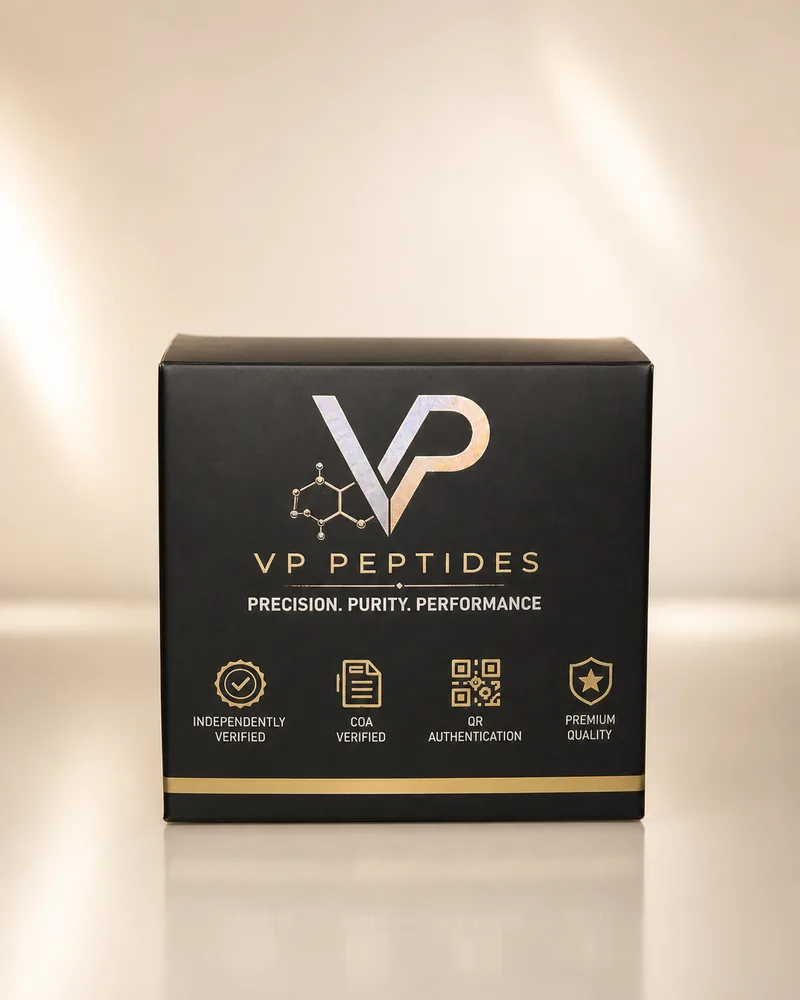
Technical profile
| Compound | 5-Amino-1MQ (5-amino-1-methylquinolinium) |
|---|---|
| Class | Small-molecule NNMT inhibitor; membrane-permeable quinolinium compound — not a peptide |
| Target | Nicotinamide N-methyltransferase (NNMT), a cytosolic methyltransferase that consumes nicotinamide, a precursor in the NAD+ salvage pathway |
| Molecular weight | ~159 g/mol (approximate, free cation; salt forms weigh more) |
| Form supplied | Powder, sealed vial |
| Storage | Powder: cool, dry place, protected from moisture and light, per lab protocol |
| Verification | HPLC purity ≥99% and identity confirmation — documented on the batch COA |
What does the research literature cover?
5-Amino-1MQ entered the literature as a tool compound for probing NNMT biology. Published preclinical work — cell-culture and rodent models — has examined it in the context of:
- NNMT enzymology: selective, membrane-permeable inhibition of nicotinamide N-methyltransferase in cellular assays.
- Cellular metabolism: models of adipocyte metabolism and metabolic regulation in which NNMT expression is altered.
- NAD+ salvage-pathway biology: because NNMT methylates nicotinamide — a key NAD+ precursor — its inhibition is studied for how it shifts cellular nicotinamide and NAD+-related metabolite pools. Researchers investigating this axis often work with NAD+ directly as well.
Important context: the published evidence base is preclinical (cell and animal models). 5-Amino-1MQ has no approved human use in any jurisdiction, and human clinical trial data are lacking. Summaries here describe what researchers have studied — they are not claims about effects in humans.
Why purity matters for 5-Amino-1MQ research
Enzyme-inhibition research results are only as reliable as the material in the vial. Synthesis by-products or degradation impurities confound assay readouts and dose-response curves. Every VP Peptides 5-Amino-1MQ batch ships with a Certificate of Analysis documenting ≥99% HPLC purity and identity confirmation from independent third-party testing.
Request catalog accessFrequently asked questions
Is 5-Amino-1MQ a peptide?
No. 5-Amino-1MQ is a small-molecule quinolinium compound, not a chain of amino acids. It is grouped with research peptides commercially because it is studied in adjacent cellular-metabolism research, but chemically it is a small-molecule enzyme inhibitor.
Is 5-Amino-1MQ approved for human use?
No. 5-Amino-1MQ is not approved by the FDA or any other regulatory agency for human use. It is supplied strictly as a research chemical for in-vitro and laboratory investigation. It is not a drug, supplement, or food ingredient.
How does 5-Amino-1MQ relate to NAD+ research?
NNMT, the enzyme 5-Amino-1MQ inhibits, methylates nicotinamide — a precursor in the NAD+ salvage pathway. Researchers therefore study NNMT inhibition alongside NAD+ biology to examine how nicotinamide availability and related metabolite pools shift in cellular models.
How should 5-Amino-1MQ be stored in the lab?
Store the powder in a cool, dry place, protected from moisture and light. Solutions should be prepared and used according to your laboratory's protocol.
NNMT inhibition in metabolic models
5-Amino-1MQ is a small-molecule, non-peptide compound studied as a membrane-permeable inhibitor of nicotinamide N-methyltransferase (NNMT). Interest in this enzyme as a metabolic research target predates the inhibitor itself: an influential 2014 study reported that antisense knockdown of NNMT in adipose tissue and liver protected mice from diet-induced obesity, a genetic observation that framed NNMT as a candidate node in energy metabolism. Because NNMT consumes both nicotinamide (a precursor in the NAD⁺ salvage pathway) and the universal methyl donor S-adenosylmethionine, its activity has been examined for links between methylation flux, NAD⁺ pools, and cellular energetics.
Work with 5-Amino-1MQ has built on that background in cell-culture and rodent systems. In differentiating pre-adipocyte cultures, the inhibitor was reported to reduce lipid accumulation in a concentration-dependent manner, and diet-induced-obese mouse studies have paired the compound with dietary interventions to probe changes in body weight, adiposity and the gut microbiome. These reports are exploratory pharmacology intended to characterize what NNMT inhibition does at the level of cells and animal models, not evidence of any effect in people.
Two points bear emphasis. First, this literature is entirely preclinical — in-vitro and animal work — and 5-Amino-1MQ is not an approved drug or supplement in any jurisdiction; it has not been the subject of established human clinical use. Second, unlike most compounds in this catalog it is a small organic molecule rather than a peptide. The summaries here describe published preclinical research and are not statements about safety or efficacy in humans.
Selected research references
- Neelakantan et al., Biochem Pharmacol 2018
- Kraus et al., Nature 2014 (NNMT knockdown, diet-induced obesity) — PubMed
- Dimet-Wiley et al., Sci Rep 2022 (NNMT inhibition + reduced-calorie diet, DIO mice) — PubMed
Related research compounds
Inicio · Catálogo de investigación · 5-Amino-1MQ
Investigación en longevidad y células · Compuesto de investigación5-Amino-1MQ: Descripción para investigación
Perfil técnico
| Compuesto | 5-Amino-1MQ (5-amino-1-metilquinolinio) |
|---|---|
| Clase | Inhibidor de NNMT de molécula pequeña; compuesto de quinolinio permeable a la membrana — no es un péptido |
| Diana | Nicotinamida N-metiltransferasa (NNMT), una metiltransferasa citosólica que consume nicotinamida, un precursor de la vía de rescate del NAD+ |
| Peso molecular | ~159 g/mol (aproximado, catión libre; las formas de sal pesan más) |
| Forma suministrada | Polvo, vial sellado |
| Almacenamiento | Polvo: lugar fresco y seco, protegido de la humedad y la luz, según el protocolo del laboratorio |
| Verificación | Pureza HPLC ≥99% y confirmación de identidad — documentado en el COA del lote |
¿Qué cubre la literatura de investigación?
5-Amino-1MQ entró en la literatura como compuesto de estudio para investigar la biología de la NNMT. El trabajo preclínico publicado — modelos de cultivo celular y de roedores — lo ha examinado en el contexto de:
- Enzimología de la NNMT: inhibición selectiva y permeable a la membrana de la nicotinamida N-metiltransferasa en ensayos celulares.
- Metabolismo celular: modelos de metabolismo de adipocitos y regulación metabólica en los que se altera la expresión de NNMT.
- Biología de la vía de rescate del NAD+: dado que la NNMT metila la nicotinamida — un precursor clave del NAD+ —, se estudia su inhibición para ver cómo desplaza los reservorios celulares de nicotinamida y de metabolitos relacionados con el NAD+. Los investigadores que estudian este eje suelen trabajar también directamente con el NAD+.
Contexto importante: la base de evidencia publicada es preclínica (modelos celulares y animales). 5-Amino-1MQ no tiene uso humano aprobado en ninguna jurisdicción, y faltan datos de ensayos clínicos en humanos. Los resúmenes aquí describen lo que los investigadores han estudiado — no son afirmaciones sobre efectos en humanos.
Por qué importa la pureza en la investigación con 5-Amino-1MQ
Los resultados de la investigación sobre inhibición enzimática son tan fiables como el material del vial. Los subproductos de síntesis o las impurezas de degradación confunden las lecturas de los ensayos y las curvas dosis-respuesta. Cada lote de 5-Amino-1MQ de VP Peptides se envía con un Certificado de Análisis que documenta una pureza HPLC ≥99% y confirmación de identidad por parte de terceros independientes.
Solicitar acceso al catálogoPreguntas frecuentes
¿Es 5-Amino-1MQ un péptido?
No. 5-Amino-1MQ es un compuesto de quinolinio de molécula pequeña, no una cadena de aminoácidos. Comercialmente se agrupa con los péptidos de investigación porque se estudia en investigación de metabolismo celular adyacente, pero químicamente es un inhibidor enzimático de molécula pequeña.
¿Está 5-Amino-1MQ aprobado para uso humano?
No. 5-Amino-1MQ no está aprobado por la FDA ni por ninguna otra agencia reguladora para uso humano. Se suministra estrictamente como producto químico de investigación para estudio in vitro y de laboratorio. No es un fármaco, suplemento ni ingrediente alimentario.
¿Cómo se relaciona 5-Amino-1MQ con la investigación del NAD+?
La NNMT, la enzima que 5-Amino-1MQ inhibe, metila la nicotinamida — un precursor de la vía de rescate del NAD+. Por eso los investigadores estudian la inhibición de la NNMT junto con la biología del NAD+ para examinar cómo cambian la disponibilidad de nicotinamida y los reservorios de metabolitos relacionados en los modelos celulares.
¿Cómo debe almacenarse 5-Amino-1MQ en el laboratorio?
Almacene el polvo en un lugar fresco y seco, protegido de la humedad y la luz. Las soluciones deben prepararse y usarse conforme al protocolo de su laboratorio.
Inhibición de la NNMT en modelos metabólicos
5-Amino-1MQ es un compuesto de molécula pequeña, no peptídico, estudiado como inhibidor permeable a membrana de la nicotinamida N-metiltransferasa (NNMT). El interés en esta enzima como diana de investigación metabólica precede al propio inhibidor: un influyente estudio de 2014 reportó que el silenciamiento antisentido de la NNMT en tejido adiposo e hígado protegía a ratones frente a la obesidad inducida por la dieta, una observación genética que situó a la NNMT como un nodo candidato en el metabolismo energético. Dado que la NNMT consume tanto nicotinamida (un precursor de la vía de rescate del NAD⁺) como el donante universal de metilos S-adenosilmetionina, su actividad se ha examinado por sus vínculos entre el flujo de metilación, los reservorios de NAD⁺ y la energética celular.
El trabajo con 5-Amino-1MQ ha ampliado ese trasfondo en sistemas de cultivo celular y de roedores. En cultivos de preadipocitos en diferenciación, se reportó que el inhibidor reducía la acumulación de lípidos de forma dependiente de la concentración, y estudios en ratones con obesidad inducida por la dieta han combinado el compuesto con intervenciones dietéticas para sondear cambios en el peso corporal, la adiposidad y el microbioma intestinal. Estos informes son farmacología exploratoria destinada a caracterizar qué hace la inhibición de la NNMT a nivel de células y modelos animales, no evidencia de ningún efecto en personas.
Cabe destacar dos puntos. Primero, esta literatura es enteramente preclínica — trabajo in vitro y en animales — y 5-Amino-1MQ no es un fármaco ni suplemento aprobado en ninguna jurisdicción; no ha sido objeto de un uso clínico humano establecido. Segundo, a diferencia de la mayoría de los compuestos de este catálogo, es una molécula orgánica pequeña y no un péptido. Los resúmenes aquí describen investigación preclínica publicada y no son afirmaciones sobre seguridad o eficacia en humanos.
Referencias de investigación seleccionadas
- Neelakantan et al., Biochem Pharmacol 2018
- Kraus et al., Nature 2014 (silenciamiento de NNMT, obesidad inducida por dieta) — PubMed
- Dimet-Wiley et al., Sci Rep 2022 (inhibición de NNMT + dieta hipocalórica, ratones DIO) — PubMed