Home · Research Catalog · MK-677
Growth-Factor Research · Secretagogue ClassMK-677 (Ibutamoren): Research Overview
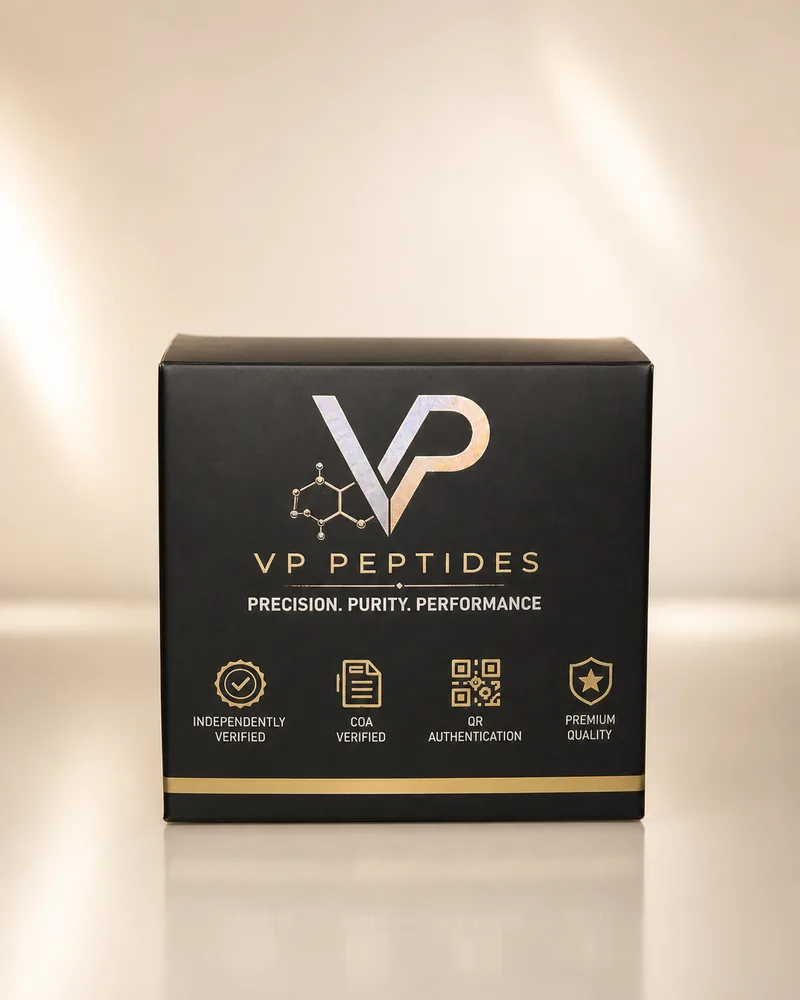
Technical profile
| Compound | MK-677 (ibutamoren; MK-0677) |
|---|---|
| Class | Nonpeptide small-molecule ghrelin-receptor (GHS-R1a) agonist — not a peptide |
| Molecular weight | ~528.7 g/mol (free base) |
| Receptor target | Ghrelin receptor (GHS-R1a) |
| Form supplied | Powder, sealed container |
| Storage | Powder: cool, dry storage, protected from light and moisture, per lab protocol |
| Verification | Purity ≥99%, sterility, endotoxins, heavy metals — documented on the batch COA |
What does the research literature cover?
MK-677 is the best-known nonpeptide compound in the secretagogue class, developed specifically to engage the ghrelin receptor without a peptide backbone. Published research has examined it in the context of:
- GHS-R1a pharmacology: receptor-binding and functional studies characterizing MK-677 as a small-molecule mimetic of the peptide secretagogues at the ghrelin receptor.
- Oral-administration secretagogue models: research on MK-677 as an orally studied secretagogue — a property that distinguishes it from peptide compounds in the class, which are not orally stable.
- Comparative mechanism studies: designs comparing nonpeptide receptor engagement with peptide agonists such as ipamorelin and hexarelin at the same target.
Important context: MK-677 has been studied in clinical research historically but has never been approved for human use in any jurisdiction. Summaries here describe what researchers have studied — they are not claims about effects in humans.
Why purity matters for MK-677 research
Small-molecule research material carries its own impurity risks: synthesis by-products, residual solvents, and degradation products can all confound receptor-pharmacology assays. Every VP Peptides MK-677 batch ships with a Certificate of Analysis documenting ≥99% purity, sterility, endotoxin and heavy-metal testing from independent third-party testing.
Request catalog accessFrequently asked questions
Is MK-677 a peptide?
No. MK-677 (ibutamoren) is a nonpeptide small molecule. It acts on the same ghrelin receptor (GHS-R1a) as peptide secretagogues such as ipamorelin and hexarelin, which is why it is carried in the growth-factor research category, but it is chemically a small-molecule compound, not a chain of amino acids.
Is MK-677 approved for human use?
No. Although MK-677 has appeared in clinical research historically, it has never been approved by the FDA or any other regulatory agency for human use. It is supplied strictly as a research chemical for laboratory investigation. It is not a drug, supplement, or food ingredient.
How should MK-677 be stored in the lab?
MK-677 powder should be kept in cool, dry storage, protected from light and moisture, in its sealed container. Handling and solution preparation should follow your laboratory's protocol for small-molecule research compounds.
What is MK-677's status in competitive sport?
Growth-hormone secretagogues, including the nonpeptide compound MK-677 (ibutamoren), are listed as prohibited substances under the World Anti-Doping Agency (WADA) Prohibited List. This is noted for informational purposes only; VP Peptides materials are supplied solely for laboratory research.
How the literature frames the GH/IGF-1 axis
Because MK-677 engages the ghrelin receptor (GHS-R1a), the research questions around it center on a well-mapped endocrine signaling pathway rather than on any single tissue. Reports in this area describe a cascade: in study models, agonist binding at GHS-R1a on pituitary somatotroph cells is associated with episodic release of growth hormone (GH), and circulating GH is in turn linked to hepatic production of insulin-like growth factor 1 (IGF-1). This receptor-to-pituitary-to-liver sequence — the somatotropic, or GH/IGF-1, axis — is the framework most publications use when they characterize what a secretagogue does at the molecular level.
Two features recur across the literature. First, the original medicinal-chemistry work that produced MK-677 set out deliberately to build a nonpeptide small molecule able to reproduce peptide-secretagogue activity at the same receptor while remaining orally stable; that design goal is documented in the foundational synthesis reports. Second, later investigational studies tracked GH and IGF-1 as measurable endpoints, describing how the axis responds over time to repeated oral administration in research settings.
These should be read as descriptions of a signaling pathway under study, not as statements about outcomes in people. MK-677 has never received FDA approval — or clearance from any comparable regulator — for any indication, and it remains an investigational compound distinct from any approved GH-axis medicine. Nothing here characterizes a benefit; it summarizes how researchers map receptor engagement onto the GH/IGF-1 axis. VP Peptides supplies MK-677 strictly as a research material for laboratory use.
Selected research references
- Chapman et al., J Clin Endocrinol Metab 1996
- Murphy et al., J Bone Miner Res 1999
- Patchett et al., Proc Natl Acad Sci U S A 1995
- Nass et al., Ann Intern Med 2008
Related research compounds
Inicio · Catálogo de investigación · MK-677
Investigación de factores de crecimiento · Clase secretagogoMK-677 (Ibutamoren): Descripción general de investigación
Perfil técnico
| Compuesto | MK-677 (ibutamoren; MK-0677) |
|---|---|
| Clase | Agonista de molécula pequeña no peptídica del receptor de grelina (GHS-R1a) — no es un péptido |
| Peso molecular | ~528.7 g/mol (base libre) |
| Diana del receptor | Receptor de grelina (GHS-R1a) |
| Forma suministrada | Polvo, envase sellado |
| Conservación | Polvo: almacenamiento fresco y seco, protegido de la luz y la humedad, según el protocolo del laboratorio |
| Verificación | Pureza ≥99%, esterilidad, endotoxinas, metales pesados: documentado en el COA del lote |
¿Qué cubre la literatura de investigación?
El MK-677 es el compuesto no peptídico más conocido de la clase secretagogo, desarrollado específicamente para actuar sobre el receptor de grelina sin una estructura peptídica. La investigación publicada lo ha examinado en el contexto de:
- Farmacología del GHS-R1a: estudios de unión al receptor y funcionales que caracterizan al MK-677 como un mimético de molécula pequeña de los secretagogos peptídicos en el receptor de grelina.
- Modelos de secretagogos de administración oral: investigación sobre el MK-677 como secretagogo estudiado por vía oral, una propiedad que lo distingue de los compuestos peptídicos de la clase, que no son estables por vía oral.
- Estudios comparativos de mecanismo: diseños que comparan la interacción no peptídica con el receptor frente a agonistas peptídicos como la ipamorelina y la hexarelina en la misma diana.
Contexto importante: el MK-677 se ha estudiado históricamente en investigación clínica, pero nunca ha sido aprobado para uso humano en ninguna jurisdicción. Los resúmenes aquí describen lo que los investigadores han estudiado; no son afirmaciones sobre efectos en humanos.
Por qué la pureza importa en la investigación con MK-677
El material de investigación de molécula pequeña conlleva sus propios riesgos de impurezas: subproductos de síntesis, disolventes residuales y productos de degradación pueden confundir los ensayos de farmacología de receptores. Cada lote de MK-677 de VP Peptides se envía con un Certificado de Análisis que documenta pureza ≥99%, esterilidad, y pruebas de endotoxinas y metales pesados realizadas por terceros independientes.
Solicitar acceso al catálogoPreguntas frecuentes
¿Es el MK-677 un péptido?
No. El MK-677 (ibutamoren) es una molécula pequeña no peptídica. Actúa sobre el mismo receptor de grelina (GHS-R1a) que los secretagogos peptídicos como la ipamorelina y la hexarelina, razón por la cual se incluye en la categoría de investigación de factores de crecimiento, pero químicamente es un compuesto de molécula pequeña, no una cadena de aminoácidos.
¿Está aprobado el MK-677 para uso humano?
No. Aunque el MK-677 ha aparecido históricamente en investigación clínica, nunca ha sido aprobado por la FDA ni por ninguna otra agencia reguladora para uso humano. Se suministra estrictamente como producto químico de investigación para estudios de laboratorio. No es un medicamento, suplemento ni ingrediente alimentario.
¿Cómo debe conservarse el MK-677 en el laboratorio?
El polvo de MK-677 debe mantenerse en almacenamiento fresco y seco, protegido de la luz y la humedad, en su envase sellado. La manipulación y la preparación de soluciones deben seguir el protocolo de su laboratorio para compuestos de investigación de molécula pequeña.
¿Cuál es el estatus del MK-677 en el deporte de competición?
Los secretagogos de la hormona del crecimiento, incluido el compuesto no peptídico MK-677 (ibutamoren), figuran como sustancias prohibidas en la Lista de Prohibiciones de la Agencia Mundial Antidopaje (AMA/WADA). Esto se indica únicamente con fines informativos; los materiales de VP Peptides se suministran exclusivamente para investigación de laboratorio.
Cómo la literatura enmarca el eje GH/IGF-1
Dado que el MK-677 actúa sobre el receptor de grelina (GHS-R1a), las preguntas de investigación en torno a él se centran en una vía de señalización endocrina bien caracterizada, más que en un tejido concreto. Los informes en esta área describen una cascada: en modelos de estudio, la unión del agonista al GHS-R1a en las células somatotropas de la hipófisis se asocia con la liberación episódica de hormona del crecimiento (GH), y la GH circulante se vincula a su vez con la producción hepática del factor de crecimiento insulínico tipo 1 (IGF-1). Esta secuencia receptor-hipófisis-hígado —el eje somatotrópico, o eje GH/IGF-1— es el marco que utilizan la mayoría de las publicaciones al caracterizar lo que hace un secretagogo a nivel molecular.
Dos rasgos se repiten en la literatura. Primero, el trabajo original de química médica que dio lugar al MK-677 se propuso deliberadamente construir una molécula pequeña no peptídica capaz de reproducir la actividad de los secretagogos peptídicos en el mismo receptor manteniéndose estable por vía oral; ese objetivo de diseño está documentado en los informes de síntesis fundacionales. Segundo, estudios de investigación posteriores registraron la GH y el IGF-1 como criterios de valoración medibles, describiendo cómo responde el eje a lo largo del tiempo ante la administración oral repetida en entornos de investigación.
Esto debe leerse como descripciones de una vía de señalización en estudio, no como afirmaciones sobre resultados en personas. El MK-677 nunca ha recibido la aprobación de la FDA —ni la autorización de ninguna agencia reguladora comparable— para ninguna indicación, y sigue siendo un compuesto de investigación distinto de cualquier medicamento aprobado del eje GH. Nada de lo aquí expuesto describe un beneficio; se resume cómo los investigadores relacionan la interacción con el receptor y el eje GH/IGF-1. VP Peptides suministra el MK-677 estrictamente como material de investigación para uso de laboratorio.
Referencias de investigación seleccionadas
- Chapman et al., J Clin Endocrinol Metab 1996
- Murphy et al., J Bone Miner Res 1999
- Patchett et al., Proc Natl Acad Sci U S A 1995
- Nass et al., Ann Intern Med 2008