Home · Research Catalog · GLOW Blend
Repair & Recovery · Research BlendGLOW Blend: Research Overview
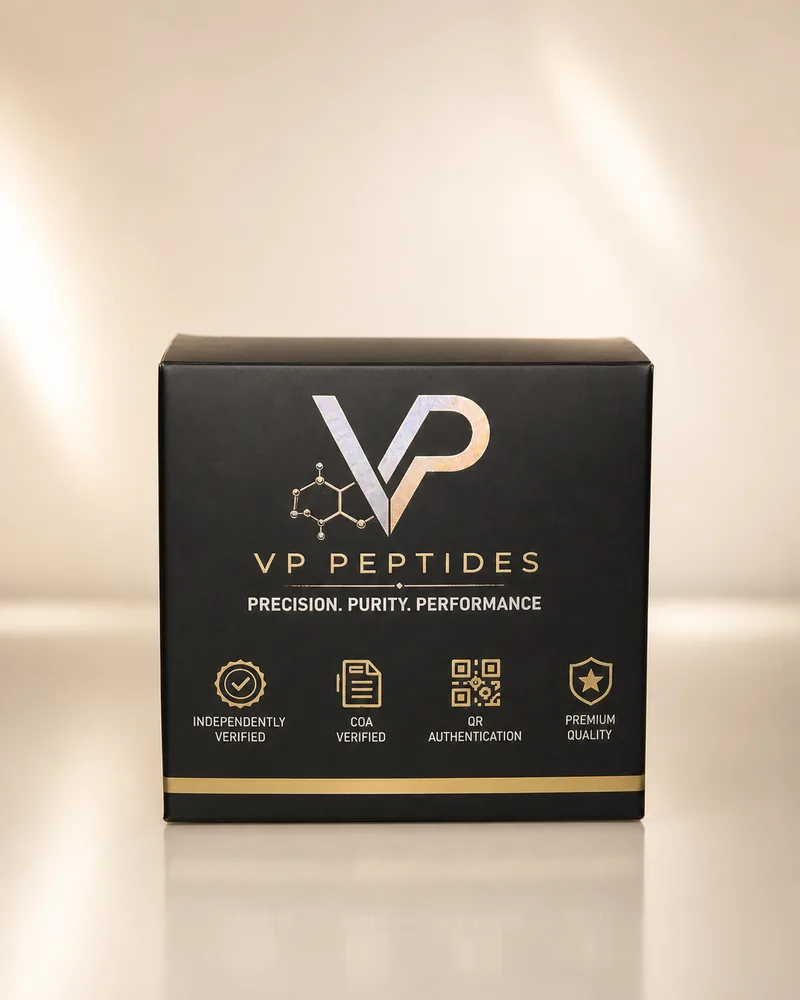
Technical profile
| Blend | GLOW (multi-peptide research blend) |
|---|---|
| Components | GHK-Cu · BPC-157 · TB-500 |
| GHK-Cu | Copper tripeptide Gly-His-Lys, naturally occurring in human plasma, studied in dermal wound and extracellular-matrix models |
| BPC-157 | Synthetic pentadecapeptide (15 amino acids) derived from a gastric juice protein, studied in preclinical tendon, ligament, and gastrointestinal models |
| TB-500 | Synthetic fragment of Thymosin β4, studied in preclinical tissue-repair and cell-migration models |
| Molecular weight | Three components — see COA for per-component specification |
| Form supplied | Lyophilized powder, sealed vial |
| Storage | Lyophilized: 2–8 °C, protected from light. |
| Verification | Per-component HPLC purity ≥99%, sterility, endotoxins, heavy metals — documented on the batch COA |
What does the research literature cover?
There is no single published literature on "GLOW" as a named entity — the blend is a laboratory convenience that supplies three individually studied research peptides together. The relevant published work covers the components:
- GHK-Cu: dermal wound models, collagen and extracellular-matrix biology, and gene-expression profiling in cultured cells.
- BPC-157: rodent models of tendon, ligament, muscle, and gastrointestinal tissue, plus studies of angiogenesis in injured tissue.
- TB-500 / Thymosin β4 fragment: preclinical studies of actin binding, cell migration, and tissue-repair biology.
The studied contexts for these components — tissue-repair signaling, angiogenesis, and skin-remodeling biology in preclinical models — overlap substantially, which is the rationale for supplying the three compounds as a combined research blend.
Important context: the published evidence base for every component is preclinical (cell and animal models). None of the components, nor the blend, has an approved human use in any jurisdiction. Summaries here describe what researchers have studied — they are not claims about effects in humans, and no cosmetic or therapeutic claims are made or implied.
Why purity matters for blend research
Blend research raises the analytical bar: a result cannot be attributed to a component unless every component is verified. Truncated sequences, inconsistent copper complexation, cross-contamination, or endotoxin load in any one peptide confounds the entire experiment. Every VP Peptides GLOW batch ships with a Certificate of Analysis documenting per-component ≥99% HPLC purity plus sterility, endotoxin and heavy-metal testing from independent third-party testing.
Request catalog accessFrequently asked questions
What exactly is in this blend?
GLOW contains three research peptides supplied together: GHK-Cu (copper tripeptide Gly-His-Lys), BPC-157 (synthetic pentadecapeptide), and TB-500 (Thymosin β4 fragment). The exact per-component quantities and specifications for your batch are documented on its Certificate of Analysis.
Is the GLOW blend approved for human use?
No. Neither the blend nor any of its components is approved by the FDA or any other regulatory agency for human use. It is supplied strictly as a research chemical for in-vitro and laboratory investigation. It is not a drug, supplement, food ingredient, or cosmetic ingredient.
What does a GLOW Certificate of Analysis include?
Each batch COA documents per-component HPLC purity (≥99% specification), per-component quantities, and sterility, endotoxin and heavy-metal screening results, along with batch number and test date.
How should the GLOW blend be stored in the lab?
Lyophilized vials should be kept at 2–8 °C and protected from light.
How are the three components studied individually?
No controlled study has evaluated the three-peptide GLOW combination, so the relevant evidence is the separate mechanistic literature on each component. The three are investigated along largely non-overlapping molecular routes.
GHK-Cu, the naturally occurring copper tripeptide, is studied for its interactions with the extracellular matrix and with gene-expression programs. Reviews summarizing microarray datasets report that the complex is associated with changes in the expression of many genes linked to matrix remodeling, antioxidant defense, and tissue repair in cultured cells and skin models (Pickart and Margolina, 2018).
BPC-157 is examined along tissue-outgrowth and angiogenesis pathways. Fibroblast studies reported up-regulation of the growth-hormone receptor, and injured-tissue models describe vascular-endothelial-growth-factor and nitric-oxide-pathway involvement (Chang and colleagues, 2014). TB-500, a synthetic fragment of Thymosin β4, is studied for actin-sequestering activity and its downstream influence on cell migration and repair biology in wound and cell-culture models (Goldstein and colleagues, 2012).
Placing three peptides with distinct proposed mechanisms in a single vial is an experimental convenience, not a validated formulation. No published study has tested whether the three interact, whether a combined preparation produces effects beyond those of the individual peptides, or whether combining them changes safety or stability. Any claim of synergy would run ahead of the data. These separate literatures also differ in maturity — GHK-Cu has a longer published record in skin and matrix biology than the injectable repair peptides — so the components should not be treated as interchangeable or additive. Everything here is preclinical (cell and animal) work on the individual components, listed so laboratory researchers can find the primary sources, and none of it is a claim about effects in humans or a cosmetic or therapeutic representation.
Selected research references
- Pickart et al., Int J Mol Sci 2018
- Perovic et al., Curr Issues Mol Biol 2022
- McGuire et al., Appl Sci 2026
- Chang et al., Molecules 2014
- Goldstein et al., Expert Opin Biol Ther 2012
Related research compounds
Inicio · Catálogo de investigación · Mezcla GLOW
Reparación y recuperación · Mezcla de investigaciónMezcla GLOW: Descripción general de investigación
Perfil técnico
| Mezcla | GLOW (mezcla de investigación multipeptídica) |
|---|---|
| Componentes | GHK-Cu · BPC-157 · TB-500 |
| GHK-Cu | Tripéptido de cobre Gly-His-Lys, presente de forma natural en el plasma humano, estudiado en modelos de heridas dérmicas y de matriz extracelular |
| BPC-157 | Pentadecapéptido sintético (15 aminoácidos) derivado de una proteína del jugo gástrico, estudiado en modelos preclínicos de tendón, ligamento y gastrointestinales |
| TB-500 | Fragmento sintético de la Timosina β4, estudiado en modelos preclínicos de reparación de tejidos y migración celular |
| Peso molecular | Tres componentes — consulte el COA para la especificación por componente |
| Forma suministrada | Polvo liofilizado, vial sellado |
| Almacenamiento | Liofilizado: 2–8 °C, protegido de la luz. |
| Verificación | Pureza HPLC por componente ≥99%, esterilidad, endotoxinas, metales pesados — documentado en el COA del lote |
¿Qué cubre la literatura de investigación?
No existe una literatura publicada única sobre "GLOW" como entidad nombrada — la mezcla es una conveniencia de laboratorio que suministra juntos tres péptidos de investigación estudiados individualmente. El trabajo publicado relevante cubre los componentes:
- GHK-Cu: modelos de heridas dérmicas, biología del colágeno y de la matriz extracelular, y perfiles de expresión génica en células cultivadas.
- BPC-157: modelos en roedores de tendón, ligamento, músculo y tejido gastrointestinal, además de estudios de angiogénesis en tejido lesionado.
- TB-500 / fragmento de Timosina β4: estudios preclínicos de unión a la actina, migración celular y biología de reparación de tejidos.
Los contextos estudiados para estos componentes — señalización de reparación de tejidos, angiogénesis y biología de remodelación de la piel en modelos preclínicos — se superponen sustancialmente, lo cual es la razón para suministrar los tres compuestos como una mezcla de investigación combinada.
Contexto importante: la base de evidencia publicada para cada componente es preclínica (modelos celulares y animales). Ninguno de los componentes, ni la mezcla, tiene un uso humano aprobado en ninguna jurisdicción. Los resúmenes aquí describen lo que los investigadores han estudiado — no son afirmaciones sobre efectos en humanos, y no se hacen ni se implican afirmaciones cosméticas o terapéuticas.
Por qué importa la pureza en la investigación de mezclas
La investigación de mezclas eleva el listón analítico: un resultado no puede atribuirse a un componente a menos que cada componente esté verificado. Secuencias truncadas, complejación de cobre inconsistente, contaminación cruzada o carga de endotoxinas en cualquiera de los péptidos confunden todo el experimento. Cada lote GLOW de VP Peptides se envía con un Certificado de Análisis que documenta una pureza HPLC por componente ≥99% además de pruebas de esterilidad, endotoxinas y metales pesados realizadas por terceros independientes.
Solicitar acceso al catálogoPreguntas frecuentes
¿Qué contiene exactamente esta mezcla?
GLOW contiene tres péptidos de investigación suministrados juntos: GHK-Cu (tripéptido de cobre Gly-His-Lys), BPC-157 (pentadecapéptido sintético) y TB-500 (fragmento de Timosina β4). Las cantidades exactas por componente y las especificaciones de su lote se documentan en su Certificado de Análisis.
¿Está la mezcla GLOW aprobada para uso humano?
No. Ni la mezcla ni ninguno de sus componentes está aprobado por la FDA o cualquier otra agencia reguladora para uso humano. Se suministra estrictamente como un producto químico de investigación para estudios in vitro y de laboratorio. No es un fármaco, suplemento, ingrediente alimentario ni ingrediente cosmético.
¿Qué incluye un Certificado de Análisis de GLOW?
Cada COA de lote documenta la pureza HPLC por componente (especificación ≥99%), las cantidades por componente y los resultados del cribado de esterilidad, endotoxinas y metales pesados, junto con el número de lote y la fecha de análisis.
¿Cómo debe almacenarse la mezcla GLOW en el laboratorio?
Los viales liofilizados deben mantenerse a 2–8 °C y protegidos de la luz.
¿Cómo se estudia cada uno de los tres componentes por separado?
Ningún estudio controlado ha evaluado la combinación de tres péptidos de GLOW, por lo que la evidencia relevante es la literatura mecanística por separado sobre cada componente. Los tres se investigan por vías moleculares en gran medida no superpuestas.
GHK-Cu, el tripéptido de cobre presente de forma natural, se estudia por sus interacciones con la matriz extracelular y con programas de expresión génica. Las revisiones que resumen conjuntos de datos de microarreglos informan que el complejo se asocia con cambios en la expresión de muchos genes vinculados a la remodelación de la matriz, la defensa antioxidante y la reparación de tejidos en células cultivadas y modelos de piel (Pickart y Margolina, 2018).
BPC-157 se examina por vías de crecimiento de tejido y angiogénesis. Estudios en fibroblastos informaron un aumento de la expresión del receptor de la hormona del crecimiento, y los modelos de tejido lesionado describen la participación del factor de crecimiento endotelial vascular y de la vía del óxido nítrico (Chang y colaboradores, 2014). TB-500, un fragmento sintético de la Timosina β4, se estudia por su actividad secuestradora de actina y su influencia posterior sobre la migración celular y la biología de reparación en modelos de herida y de cultivo celular (Goldstein y colaboradores, 2012).
Colocar tres péptidos con mecanismos propuestos distintos en un solo vial es una conveniencia experimental, no una formulación validada. Ningún estudio publicado ha probado si los tres interactúan, si una preparación combinada produce efectos más allá de los de los péptidos individuales, o si combinarlos modifica la seguridad o la estabilidad. Cualquier afirmación de sinergia se adelantaría a los datos. Estas literaturas separadas también difieren en madurez — GHK-Cu tiene un registro publicado más largo en biología de la piel y de la matriz que los péptidos de reparación inyectables — por lo que los componentes no deben tratarse como intercambiables ni aditivos. Todo lo aquí presentado es trabajo preclínico (celular y animal) sobre los componentes individuales, enumerado para que los investigadores de laboratorio puedan encontrar las fuentes primarias, y nada de ello constituye una afirmación sobre efectos en humanos ni una representación cosmética o terapéutica.
Referencias de investigación seleccionadas
- Pickart et al., Int J Mol Sci 2018
- Perovic et al., Curr Issues Mol Biol 2022
- McGuire et al., Appl Sci 2026
- Chang et al., Molecules 2014
- Goldstein et al., Expert Opin Biol Ther 2012