Home · Research Catalog · Retatrutide
Metabolic Research · Triple AgonistRetatrutide: Research Overview
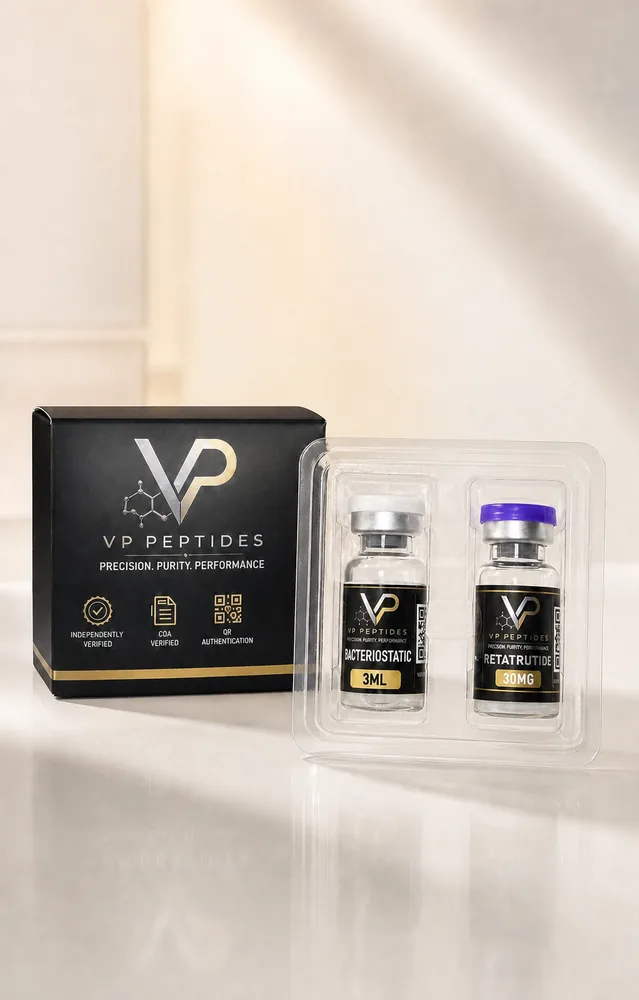
Retatrutide (LY3437943) is an investigational triple GIP/GLP-1/glucagon receptor agonist in Phase 3 trials. Human data are growing but it is not approved for any use and cannot be legally compounded. Present it as investigational research material, never as an approved product.
Technical profile
| Compound | Retatrutide (LY3437943) |
|---|---|
| Class | Synthetic peptide, triple agonist of the GIP, GLP-1, and glucagon receptors |
| Structure | ~39-amino-acid backbone with a fatty-acid (lipidation) modification |
| Molecular weight | ~4731.3 g/mol (approximate) |
| Category | Metabolic research / incretin pharmacology |
| Development status | Investigational compound in clinical development (phase 3 trials by Eli Lilly); not an approved drug in any jurisdiction |
| Form supplied | Lyophilized powder, sealed vial |
| Storage | Lyophilized: 2–8 °C, protected from light. |
| Verification | HPLC purity ≥99%, sterility, endotoxins, heavy metals — documented on the batch COA |
Evidence at a glance
Research evidence is not one category. Human, animal (preclinical) and in-vitro / mechanistic data differ in strength — often sharply. VP Peptides separates them so no single line overstates the whole picture. Ratings are deliberately conservative and describe the published evidence base, not any effect in humans.
- Human efficacy or safety of the research material as sold (not the clinical-trial or any approved product)
- Long-term human safety and outcomes for any use
- Identity, purity and stability of research-grade material versus the characterized investigational compound
What does the research literature cover?
Retatrutide is distinctive in the incretin research field because it engages three receptors — GIP, GLP-1, and glucagon — rather than one or two. Published research and laboratory investigation contexts include:
- Multi-receptor incretin pharmacology: receptor-binding and signaling studies comparing single, dual, and triple agonism at the GIP, GLP-1, and glucagon receptors.
- Metabolic and energy-balance models: preclinical models used to characterize how simultaneous engagement of the three receptor pathways affects metabolic signaling.
- Peptide engineering: study of fatty-acid modification as a strategy for extending peptide half-life, a design approach shared with other lipidated incretin-class peptides.
Important context: Retatrutide is an investigational compound in ongoing clinical development by Eli Lilly. It is not an approved drug anywhere, and summaries here describe areas of laboratory investigation — they are not claims about effects, safety, or efficacy in humans.
Why purity matters for Retatrutide research
A long, chemically modified peptide such as Retatrutide is demanding to synthesize: truncated sequences, deletion impurities, incomplete lipidation, or endotoxin contamination can all confound receptor-pharmacology experiments. Every VP Peptides Retatrutide batch ships with a Certificate of Analysis documenting ≥99% HPLC purity plus sterility, endotoxin and heavy-metal testing from independent third-party testing.
Request catalog accessFrequently asked questions
Is Retatrutide an approved drug?
No. Retatrutide is an investigational compound in clinical development (phase 3 trials conducted by Eli Lilly) and is not approved by the FDA or any other regulatory agency anywhere. Research-grade Retatrutide is supplied strictly for laboratory investigation — it is not a drug, supplement, or food ingredient, and it is not for human or veterinary use.
What does a Retatrutide Certificate of Analysis include?
Each batch COA documents HPLC purity (≥99% specification), sterility, endotoxin and heavy-metal screening results, along with batch number and test date.
How should Retatrutide be stored in the lab?
Lyophilized vials should be kept at 2–8 °C and protected from light.
How does Retatrutide differ from tirzepatide and semaglutide?
The three compounds differ in receptor coverage. Semaglutide is studied as a single (GLP-1 receptor) agonist, tirzepatide as a dual GIP/GLP-1 receptor agonist, and Retatrutide as a triple agonist that additionally engages the glucagon receptor. This makes the set a common comparison framework in incretin-pharmacology research.
Triple GIP/GLP-1/glucagon agonism, in context
What sets retatrutide apart in the incretin literature is that it engages three receptors at once. Most incretin-class molecules studied to date act on a single receptor (the GLP-1 receptor) or two (GIP and GLP-1); retatrutide adds a third arm — agonism at the glucagon receptor. The research question under study is what that third arm contributes. In the published work, GLP-1 and GIP signaling is discussed in relation to appetite and glucose-handling pathways, while glucagon-receptor signaling is investigated for its relationship to hepatic metabolism and energy expenditure. Combining all three in one molecule is what the literature characterizes as "triagonism," and the mechanistic question is whether adding glucagon-receptor engagement to the incretin axis alters metabolic signaling in ways single or dual agonists do not.
This mechanism is examined in investigational clinical research, not in approved therapy. A Phase 2 randomized trial reported dose-dependent metabolic changes among study participants (Jastreboff et al., N Engl J Med 2023), and a separate Phase 2a study examined the molecule in a metabolic liver-disease model (Sanyal et al., Nat Med 2024). It has since advanced into the Phase 3 TRIUMPH program, a set of registrational trials in adiposity-related conditions (ClinicalTrials.gov — NCT05929066 (2023)). These are investigational studies designed to test hypotheses about the molecule; they are not evidence of a marketable benefit.
This bears repeating plainly: retatrutide is an investigational compound. It is not approved by the FDA or any other regulator for any use, it cannot be legally compounded, and none of the trial findings above describe an effect of research-grade material as sold. The literature summarized here concerns the molecule and its mechanism as characterized in the scientific record — it is not a claim about safety, efficacy, or any outcome for VP Peptides' research material.
Selected research references
- Jastreboff et al., N Engl J Med 2023 — Phase 2 trial (LY3437943)
- Sanyal et al., Nat Med 2024
- ClinicalTrials.gov — NCT05929066 (TRIUMPH-1, 2023)
Related research compounds
Inicio · Catálogo de investigación · Retatrutida
Investigación metabólica · Agonista tripleRetatrutida: Descripción general para investigación
La retatrutida (LY3437943) es un agonista triple de los receptores GIP/GLP-1/glucagón en investigación, en ensayos de fase 3. Los datos humanos están creciendo, pero no está aprobada para ningún uso y no puede formularse legalmente. Preséntala como material de investigación en desarrollo, nunca como un producto aprobado.
Perfil técnico
| Compuesto | Retatrutida (LY3437943) |
|---|---|
| Clase | Péptido sintético, agonista triple de los receptores GIP, GLP-1 y glucagón |
| Estructura | Esqueleto de ~39 aminoácidos con una modificación de ácido graso (lipidación) |
| Peso molecular | ~4731.3 g/mol (aproximado) |
| Categoría | Investigación metabólica / farmacología de incretinas |
| Estado de desarrollo | Compuesto en investigación en desarrollo clínico (ensayos de fase 3 de Eli Lilly); no es un medicamento aprobado en ninguna jurisdicción |
| Forma suministrada | Polvo liofilizado, vial sellado |
| Almacenamiento | Liofilizado: 2–8 °C, protegido de la luz. |
| Verificación | Pureza HPLC ≥99%, esterilidad, endotoxinas, metales pesados — documentado en el COA del lote |
Evidencia de un vistazo
La evidencia de investigación no es una sola categoría. Los datos humanos, animales (preclínicos) e in vitro / mecanísticos difieren en solidez — a menudo de forma marcada. VP Peptides los separa para que ninguna línea exagere el panorama completo. Las valoraciones son deliberadamente conservadoras y describen la base de evidencia publicada, no ningún efecto en humanos.
- La eficacia o seguridad en humanos del material de investigación tal como se vende (no el de los ensayos clínicos ni ningún producto aprobado)
- La seguridad y los resultados a largo plazo en humanos para cualquier uso
- La identidad, pureza y estabilidad del material de grado investigación frente al compuesto en investigación caracterizado
¿Qué cubre la literatura de investigación?
La retatrutida es distintiva en el campo de la investigación de incretinas porque activa tres receptores — GIP, GLP-1 y glucagón — en lugar de uno o dos. Los contextos de investigación publicada e investigación de laboratorio incluyen:
- Farmacología de incretinas multirreceptor: estudios de unión a receptores y señalización que comparan el agonismo simple, dual y triple en los receptores GIP, GLP-1 y glucagón.
- Modelos metabólicos y de balance energético: modelos preclínicos utilizados para caracterizar cómo la activación simultánea de las tres vías de receptores afecta a la señalización metabólica.
- Ingeniería de péptidos: estudio de la modificación con ácido graso como estrategia para prolongar la vida media del péptido, un enfoque de diseño compartido con otros péptidos lipidados de la clase de las incretinas.
Contexto importante: la retatrutida es un compuesto en investigación en desarrollo clínico en curso por Eli Lilly. No es un medicamento aprobado en ningún lugar, y los resúmenes aquí describen áreas de investigación de laboratorio — no son afirmaciones sobre efectos, seguridad o eficacia en humanos.
Por qué importa la pureza en la investigación con retatrutida
Un péptido largo y químicamente modificado como la retatrutida es exigente de sintetizar: las secuencias truncadas, las impurezas por deleción, la lipidación incompleta o la contaminación por endotoxinas pueden confundir los experimentos de farmacología de receptores. Cada lote de retatrutida de VP Peptides se envía con un Certificado de Análisis que documenta una pureza HPLC ≥99% además de pruebas de esterilidad, endotoxinas y metales pesados realizadas por terceros independientes.
Solicitar acceso al catálogoPreguntas frecuentes
¿Es la retatrutida un medicamento aprobado?
No. La retatrutida es un compuesto en investigación en desarrollo clínico (ensayos de fase 3 realizados por Eli Lilly) y no está aprobada por la FDA ni por ninguna otra agencia regulatoria en ningún lugar. La retatrutida de grado investigación se suministra estrictamente para investigación de laboratorio — no es un fármaco, suplemento ni ingrediente alimentario, y no es para uso humano ni veterinario.
¿Qué incluye un Certificado de Análisis de retatrutida?
Cada COA de lote documenta la pureza HPLC (especificación ≥99%), los resultados de las pruebas de esterilidad, endotoxinas y metales pesados, junto con el número de lote y la fecha de análisis.
¿Cómo debe almacenarse la retatrutida en el laboratorio?
Los viales liofilizados deben conservarse a 2–8 °C y protegidos de la luz.
¿En qué se diferencia la retatrutida de la tirzepatida y la semaglutida?
Los tres compuestos difieren en la cobertura de receptores. La semaglutida se estudia como agonista simple (del receptor GLP-1), la tirzepatida como agonista dual de los receptores GIP/GLP-1 y la retatrutida como agonista triple que además activa el receptor de glucagón. Esto convierte al conjunto en un marco de comparación habitual en la investigación de la farmacología de incretinas.
El agonismo triple GIP/GLP-1/glucagón, en contexto
Lo que distingue a la retatrutida en la literatura de incretinas es que activa tres receptores a la vez. La mayoría de las moléculas de la clase de las incretinas estudiadas hasta la fecha actúan sobre un solo receptor (el receptor GLP-1) o sobre dos (GIP y GLP-1); la retatrutida añade un tercer brazo — el agonismo en el receptor de glucagón. La pregunta de investigación en estudio es qué aporta ese tercer brazo. En los trabajos publicados, la señalización de GLP-1 y GIP se analiza en relación con las vías del apetito y del manejo de la glucosa, mientras que la señalización del receptor de glucagón se investiga por su relación con el metabolismo hepático y el gasto energético. Combinar los tres en una sola molécula es lo que la literatura caracteriza como "triagonismo", y la pregunta mecanística es si añadir la activación del receptor de glucagón al eje de las incretinas altera la señalización metabólica de formas que los agonistas simples o duales no logran.
Este mecanismo se examina en investigación clínica en desarrollo, no en una terapia aprobada. Un ensayo aleatorizado de fase 2 informó cambios metabólicos dependientes de la dosis entre los participantes del estudio (Jastreboff et al., N Engl J Med 2023), y un estudio de fase 2a independiente examinó la molécula en un modelo de enfermedad hepática metabólica (Sanyal et al., Nat Med 2024). Desde entonces ha avanzado al programa de fase 3 TRIUMPH, un conjunto de ensayos de registro en condiciones relacionadas con la adiposidad (ClinicalTrials.gov — NCT05929066 (2023)). Son estudios en investigación diseñados para poner a prueba hipótesis sobre la molécula; no son prueba de un beneficio comercializable.
Conviene repetirlo con claridad: la retatrutida es un compuesto en investigación. No está aprobada por la FDA ni por ningún otro organismo regulador para ningún uso, no puede formularse legalmente, y ninguno de los hallazgos de los ensayos anteriores describe un efecto del material de grado investigación tal como se vende. La literatura resumida aquí trata sobre la molécula y su mecanismo tal como se caracterizan en el registro científico — no es una afirmación sobre la seguridad, la eficacia ni ningún resultado del material de investigación de VP Peptides.
Referencias de investigación seleccionadas
- Jastreboff et al., N Engl J Med 2023 — ensayo de fase 2 (LY3437943)
- Sanyal et al., Nat Med 2024
- ClinicalTrials.gov — NCT05929066 (TRIUMPH-1, 2023)